Walk into any high-end boutique and you'll notice something interesting: the price tags don't make you think twice. They make you want the product more. That's not an accident. It's the result of decades of deliberate brand architecture built around one of the most powerful insights in consumer psychology: price itself is a signal of quality.
For businesses trying to grow beyond commodity territory, understanding the mechanics of premium pricing isn't optional. It's the foundation. The brands that command exceptional margins aren't just delivering better products. They're delivering a better story, a better feeling, and a better identity. And they're doing it through a very specific set of psychological tools.
The Price-Quality Heuristic: Why Higher Price Signals Higher Quality
When people lack enough information to evaluate a product objectively, they use shortcuts, and the most reliable shortcut is price. The price-quality heuristic is the deeply ingrained assumption that higher price equals higher quality. It's why a R500 bottle of wine tastes better than a R50 one, even when blind taste tests prove otherwise.
Luxury brands don't just accept this heuristic. They weaponise it. By pricing high, they activate the assumption of quality before the customer has even touched the product. The price becomes a pre-emptive quality endorsement.
The practical implication: if you're constantly competing on price, you're actively signalling that your product is less valuable. Raising your price isn't just about margin. It's about positioning. In many categories, the brand with the highest price is perceived as the best, regardless of objective quality differences.
Price Anchoring: How Reference Points Shape Perceived Value
Anchoring is one of the most powerful and least understood tools in brand strategy. The first price a customer sees becomes the reference point, the "anchor," against which everything else is judged.
Consider how luxury car brands structure their ranges. The ultra-premium flagship model at R2 million isn't expected to sell in volume. Its job is to anchor the perception of the brand, so that the R600,000 model feels accessible by comparison. Every price in the range gets pulled upward by the anchor at the top.
The most expensive item in your range isn't just a product. It's a psychological tool that makes everything else feel more reasonable.
For brands looking to move upmarket, this means introducing a genuinely premium tier, not as an upsell, but as an anchor. The presence of a high-priced option recalibrates how customers perceive your entire offering.
Scarcity and Exclusivity: How Luxury Brands Create Desire
Nothing amplifies desire quite like the fear of missing out. Scarcity, real or perceived, is one of the most reliably effective tools in luxury brand management. When something is difficult to acquire, the brain automatically assigns it more value.
This plays out in several ways:
- Limited editions: a defined production run signals that the item won't exist forever, creating urgency
- Waitlists: requiring customers to wait for a product reverses the usual dynamic; instead of the brand chasing the customer, the customer is pursuing the brand
- Invitation-only access: making membership or purchase conditional on selection or status
- Geographic exclusivity: only available in certain cities, markets, or channels
Scarcity works because it transforms a commercial transaction into something that feels earned. And what's earned is treasured.
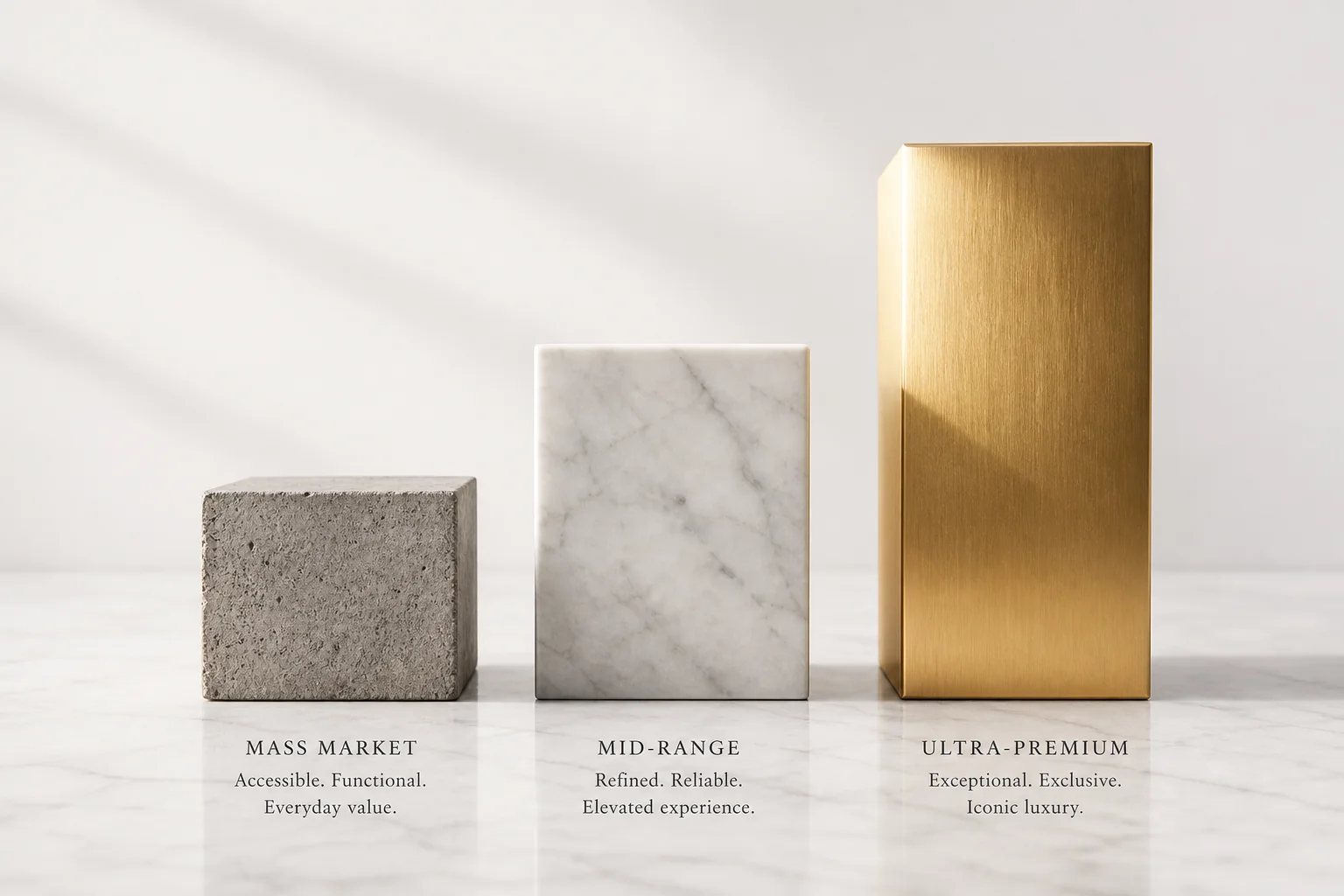
Functional Value vs. Emotional Value: Where Premium Margins Live
Every product has two types of value: functional and emotional. Functional value is what the product does: performance, durability, and features. Emotional value is how owning it makes you feel: the status it confers, the identity it reinforces, the aspiration it embodies.
The critical insight: premium pricing is almost always justified by emotional value, not functional value. A Rolls-Royce is not fifty times better at getting you from A to B than a Toyota. But owning one communicates fifty times more about who you are. Customers aren't just buying transportation. They're buying a statement.
For brands building premium positioning, this means shifting the conversation from features to feelings. Don't tell customers what your product does. Tell them who they become when they own it. The emotional premium is where margin lives.
The Premium Gap Strategy: Why Separating from the Market Works
One of the more counterintuitive moves in premium brand building is deliberately leaving the affordable end of the market. By maintaining a wide gap between your prices and the commodity alternatives, you avoid a dangerous association: the perception that your brand is "basically the same thing but more expensive."
Brands that inch upmarket while keeping low-priced entry options active often find that the premium positioning doesn't hold. Customers anchor on the low price, and the high-priced items feel like a markup rather than a different category entirely.
True premium positioning requires a clean break. You're not competing with accessible alternatives. You're in a different conversation entirely.
How to Build Premium Pricing Into Your Brand Strategy
Premium pricing isn't something you bolt on after the fact. It's built into the brand architecture from the beginning, or rebuilt through a deliberate repositioning. Here's what that looks like in practice:
- Set the price first, then build the product to deserve it. Starting with the price you need to command forces you to engineer every element of the product and experience to justify it.
- Invest in the container as much as the content. Packaging, presentation, and unboxing are part of the product for premium brands. The experience of receiving something communicates its value before the product is even used.
- Create deliberate friction. Premium brands don't make it easy to buy. Waitlists, appointment-only showrooms, and limited availability are not obstacles. They are brand assets.
- Control your distribution ruthlessly. Being available everywhere signals mass-market status. Premium brands choose their channels deliberately and guard them.
- Never discount publicly. A sale event destroys years of premium positioning in a weekend. If you must move inventory, do it privately, selectively, and sparingly.
Premium Pricing in the South African Market
In the South African market, there's a significant and largely untapped opportunity for local brands to command genuine premium positioning, not by mimicking European luxury conventions, but by leaning into what makes South African craft, design, and culture genuinely distinctive.
Consumers globally are increasingly skeptical of premium pricing that isn't backed by authentic story and genuine craft. South African brands that can articulate their heritage, their process, and their cultural rootedness have a compelling case for premium, not despite being South African, but because of it.
The brands doing this well, from artisanal winemakers in Stellenbosch to independent fashion houses in Cape Town, aren't just charging more. They're building narratives that make the price feel inevitable. Explore our portfolio of South African brand projects to see how premium positioning works in practice.
Final Thoughts: Premium Pricing as a Brand Decision
Premium pricing isn't about charging more for the same thing. It's about building something worth paying more for, and communicating that value through every touchpoint, from the price tag to the packaging to the service experience to the brand story.
The psychology is clear: customers want to pay for things that make them feel good, that signal taste and discernment, and that belong to a world they aspire to. The brands that understand this don't compete on value in the traditional sense. They create a category of their own, one where price is a feature, not a barrier.